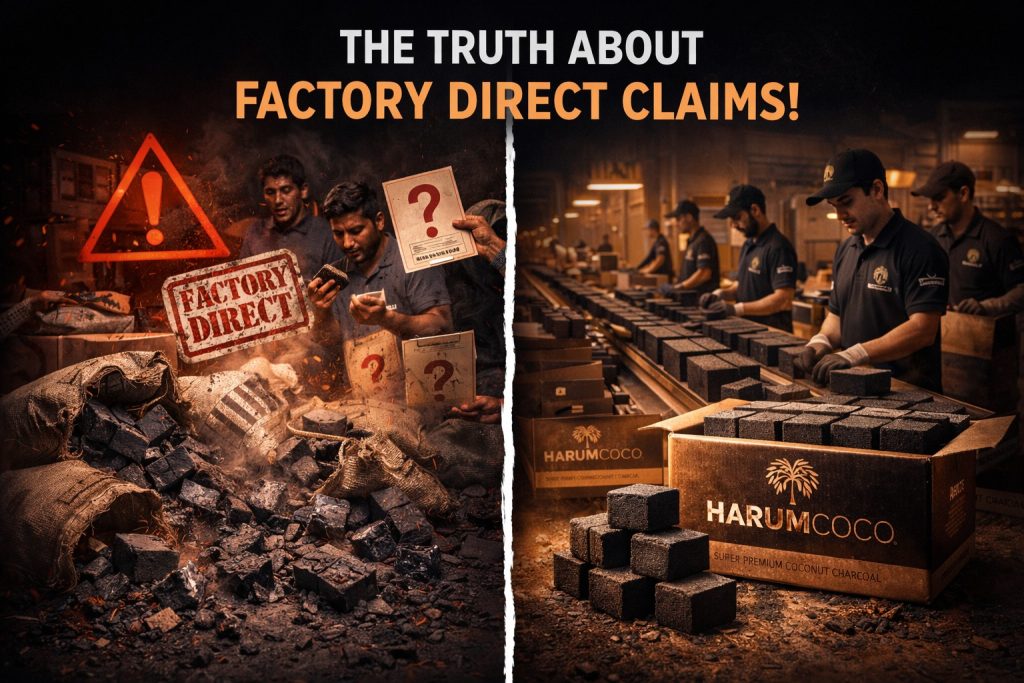
“Factory-direct.”
It is one of the most powerful phrases in the Charcoal Industry. The term suggests better prices, tighter quality control, faster production, and direct accountability. For buyers, especially importers and distributors, it sounds like the safest and smartest choice.
But here is the uncomfortable truth: not every factory-direct claim reflects real manufacturing control.
In many cases, the label is used loosely. Some companies coordinate production without owning facilities. Others rely on partner factories while marketing themselves as direct manufacturers. The result is a blurred line between genuine production-based suppliers and intermediaries operating behind factory imagery.
Understanding what factory-direct truly means can protect your business from hidden risks.
Factory-Direct in the Charcoal Industry: Definition vs Reality

In theory, factory-direct means a company owns or fully controls its production facilities. They manage raw material sourcing, carbonization, briquette pressing, drying, cutting, packaging, and quality inspection under one coordinated system.
In reality, the Charcoal Industry operates with multiple layers. A company may rent factory space. Another may outsource carbonization but handle briquetting. Some may simply act as coordinators, placing orders with independent factories and branding the output as their own.
The distinction matters because production control directly affects consistency, pricing stability, and long-term supply reliability.
Why Factory-Direct Claims Are So Attractive
The Charcoal Industry is highly competitive. Buyers want lower prices without sacrificing performance. “Factory-direct” promises exactly that — eliminating middlemen and reducing markup.
For newer importers, the appeal is strong. It suggests transparency and operational efficiency. But the term itself is not regulated. There is no universal certification that verifies who truly owns and controls a factory.
Without careful verification, buyers may assume direct production while unknowingly working with layered sourcing structures.
The Risk of Partial Control

Some companies genuinely work closely with factories but do not fully control them. While this model can function well in stable conditions, it introduces vulnerability when market pressures rise.
For example, during raw material shortages or increased demand, independent factories may prioritize larger or older clients. If your “factory-direct” partner does not own the production facility, your orders could be delayed or adjusted.
In the Charcoal Industry, supply consistency depends not only on relationships but on structural authority over production lines.
Read More Shisha Charcoal Characteristics
VISIT US COCONUT CHARCOAL SHISHA FACTORY
Quality Consistency Starts at the Source
Burn time, ash percentage, cube density, moisture level — these are not accidental outcomes. They are the result of controlled carbonization temperature, calibrated pressing machines, and standardized drying times.
When a company has true factory oversight, adjustments can be made internally. Testing can be repeated quickly. Batch inconsistencies can be corrected before shipment.
If production control is indirect, quality corrections take longer and may depend on negotiation rather than direct action. In export markets, this delay can affect contracts, distributor trust, and brand credibility.
The Charcoal Industry rewards those who can repeat quality, not just promise it.
Transparency Is the Real Indicator
Rather than focusing solely on the “factory-direct” label, serious buyers in the Charcoal Industry look for transparency. They ask specific questions:
How is raw material sourced?
What production capacity is available monthly?
How is batch testing performed?
What happens when defects are found?
Companies with genuine production systems can answer confidently and clearly. Those operating through complex intermediary structures often respond with general statements rather than process details.
Transparency reveals structure. Structure determines stability.
Conclusion: Look Beyond the Label
The phrase “factory-direct” carries weight in the Charcoal Industry, but labels alone do not guarantee production control. What matters is operational structure, transparency, and accountability.
Before committing to long-term agreements, buyers should examine who truly controls the production process and how consistency is maintained.
At HarumCoco, our focus is on structured manufacturing systems, monitored production stages, and clear communication from raw material to shipment. We believe stability is not created by marketing terms but by disciplined operational control.
Because in the Charcoal Industry, the truth behind the claim determines the strength of the partnership.

Harumcoco – Coconut Charcoal Shisha Supplier
Harumcoco Indonesia